
Open Consultation
SQE assessment regulations consultation
- The consultation period ends at 23.59 on 11 February 2027.
- You can download the consultation paper or read it below.
- Watch - SQE consultation: improved flexibility, same high standards.
- How to respond.
About this consultation
All those wishing to qualify as a solicitor need to pass the Solicitor's Qualifying Examination (SQE), a single assessment that tests both a candidate's knowledge and skills.
We are committed to reviewing the SQE and making any improvements that maintain confidence in qualification in the long term, while preserving rigorous, fair and trusted standards.
We are therefore consulting on proposals to change the SQE Assessment Regulations to help increase flexibility and accessibility for candidates. To inform our position, we engaged with a range of stakeholders including SQE training providers, law firms, SQE candidates, representative bodies and our SQE assessment provider, Kaplan. We would welcome further views from all interested stakeholders as part of this consultation.
We are also consulting on minor amendments relating to the Assessment Board's role. These amendments could be implemented sooner than the changes to increase flexibility and accessibility, so we propose implementing them separately to, and earlier than, the main changes.
The consultation runs until 11 February 2027.
After this consultation closes, we will analyse responses and decide how to proceed before we publish a response. Should we decide to change our current Assessment Regulations, we are required to seek approval from the Legal Services Board (LSB). If the LSB approves any changes, we would expect them to come into effect in 2028 following implementation project work.
You can find our assessment of the regulatory and equality impacts of these changes in our Regulatory and Equality Impact Assessment (REIA). We have also provided some information about how our proposed changes could be applied to current SQE candidates who may be at different stages along the SQE pathway.
Context
The SQE was introduced in 2021 with the aim of creating a consistent standard for qualifying as a solicitor in England and Wales. It replaced a system where more than 30 different education organisations set and marked their own assessments, leading to differences in pass rates which were not easily attributable or explained.
The SQE makes sure every aspiring solicitor is assessed to the same high standard, regardless of their background or route to qualification. The SQE has reshaped solicitor training, provided greater assurance of consistently high standards at the point of admission as a solicitor, and provided more flexibility to candidates than under the Legal Practice Course route. The rules governing the SQE are set out in the SQE Assessment Regulations.
Our data shows that the SQE is robust – it is functioning well as an assessment and in line with best practice. However, feedback from candidates tells us that some find the experience of taking the SQE stressful and exhausting. Candidates have shared with us that this can affect their performance in the exams and, sometimes, their mental health and wellbeing.
Delivering an assessment that offers accessibility and flexibility has been a core objective since we introduced the SQE. We are committed to improving the candidate experience where we can and where it will not affect standards.
In the five years since the introduction of the SQE, we have collected data and listened carefully to stakeholder perspectives. We are now better placed to adjust the SQE to improve the candidate experience, confident these changes will not impact the high standards of admission. For example, we have recently announced that from January 2027, the number of questions in each SQE1 assessment – Functioning Legal Knowledge 1 (FLK1) and Functioning Legal Knowledge 2 FLK2 – will be reduced from 180 to 170. This will give candidates more time to answer each question. Questions will also be grouped together so that candidates will know which subject areas will be covered in each part of the paper.
Building on these improvements, we are now proposing further changes to improve the candidate experience and increase accessibility and flexibility. The changes we propose are:
- Removing the requirement for candidates to sit FLK1 and FLK2 in the same sitting (splitting the FLK).
- Removing the cap on the number of resits candidates can take.
- Changing the starting point for how long an FLK1 or FLK2 pass is 'valid' for.
The full detail of these changes is outlined below.
Following any refinement of our proposals once we have reviewed consultation feedback, we aim to implement these three changes at the same time.
To fund the changes needed to implement these requirements, we anticipate the SQE candidate fee will increase by £1.47 for FLK1 and FLK2, and by £1.49 for SQE2. If the expected timeline for implementation is achieved, the increase would apply to the 2027/28 candidate fee – applying to SQE assessments booked after September 2027.
We are also taking this opportunity to consult on some minor amendments to the SQE Assessment Regulations relating to the Assessment Board's role in governance of mitigating circumstances and malpractice claims. There are no costs associated with these additional minor amendments. As these can be implemented promptly once the LSB makes a decision, we propose to update the Assessment Regulations twice, first with these amendments (see Annex 3), and secondly to incorporate the wider changes listed above (see Annex 4).
Open allWe currently require SQE candidates to take both parts of SQE1 (FLK1 and FLK2) in the same assessment window. This requirement is specified in the SQE Assessment Regulations – Regulation 4.3.
This requirement means candidates have to sit both parts of the assessment on two separate days within a two-week period. Each day is split into two sessions of two hours and 33 minutes, with 85 questions in each session. There is a one-hour break between sessions.
During their preparation, candidates must cover the whole of the SQE1 syllabus. Many candidates and other stakeholders tell us that candidates find the experience stressful and fatiguing, and that it can affect candidates' experience in the assessments and their mental health. These effects can be more pronounced for apprenticeship candidates, or candidates who are working, and/or with caring or other responsibilities.
We are proposing to remove the requirement for FLK1 and FLK2 to be attempted in the same sitting for the following reasons.
First, by having the option to split FLK sittings candidates would have greater flexibility in choosing a pathway through the SQE that works best for them. It will give candidates greater opportunity to spread the preparation time, cost and cognitive burden of the SQE1 assessments over an extended period, if that is what they prefer. Minimising the stress of preparing for the SQE and reducing cognitive load on candidates ahead of, and during, an assessment window, will better support their wellbeing and might allow some candidates to improve their performance.
Second, our data also show that candidates typically perform better on FLK1 than on FLK2 – in 2025 the difference in pass rates was three per cent higher for FLK1 than FLK2. We cannot definitively say why this is the case, but the following factors may be relevant:
- attempting FLK2 a few days after FLK1 could increase fatigue and cognitive load;
- some candidates might make a tactical decision to focus on either FLK1 or FLK2, knowing that if they pass one but fail the other, they will only have to re-take one exam.
Third, there is no standard setting or marking reason for why FLK1 and FLK2 should be sat together. They are separate assessments which can be treated independently – unlike the stations in SQE2 where standards are set across all assessment tasks.
For these reasons we believe there is a strong case to remove the requirement to take both parts of the FLK in the same window and change the regulations to this end. There will be no impact on the high standards of the SQE due to this change.
To note, candidates will retain the option to sit both FLK assessments at the same time if they want to. We anticipate there will continue to be a high number of candidates who will still sit them together. We expect part-time, self-funded, or candidates who have caring responsibilities to be the most likely to take advantage of this change. We do not anticipate any negative regulatory or equality impacts from these changes. The reason for this is set out in the REIA.
As part of our pre-consultation engagement, stakeholders have asked whether further SQE1 sittings would be introduced to give candidates more opportunities to take the FLK assessment that they have not yet sat. We are exploring this. We welcome your thoughts on what is important in relation to the scheduling of assessments.
Question 1
To what extent do you agree or disagree with the proposal to remove the requirement for candidates to take FLK1 and FLK2 in the same assessment window?
Question 2
If candidates could take FLK1 and FLK2 in separate assessment windows, which of the following scheduling options would be important to you or your organisation?
- the ability to progress quickly from an FLK to the next FLK sitting
- the ability to take either FLK at any SQE1 sitting
- the ability to have a large period of time between FLK sittings (eg more than two or three months)
- the ability to attempt SQE1 (ie both FLK1 and FLK2) in January and SQE2 in April (in time for results to be issued before September)
- the ability to progress quickly from SQE1 to SQE2
- other.
Question 3
Are there any implications (positive or negative), for you or your organisation if the requirement to take FLK1 and FLK2 in the same assessment window was removed?
There is currently a cap of three attempts for each component of the SQE within six years from the date candidates first sit an SQE assessment (FLK1, FLK2, or SQE2).
There is a strong case for lifting the attempt cap to improve candidate flexibility and accessibility. Five years on from the introduction of the SQE, assessment data confirms that making this change would not affect the reliability or integrity of the SQE (see second point below). We are making this proposal for the following reasons.
First, we have heard from candidates and providers that the cap of three attempts adds significant pressure to candidates on their third attempt as the consequences of failure are high. This is because if candidates fail three times, they must wait six years from the date the SQE was first attempted before they are able to attempt it again. At the end of the six years, previous passes are removed from candidates' records and they must restart the SQE assessment journey.
Removing the attempt cap lessens the consequences of failure for individuals and will hopefully reduce the pressure candidates face, especially those on their third attempt. This should mean that candidates do not need to worry about becoming blocked from attempting the SQE again, unlike in a capped system. However, candidates would still need to think carefully about their likelihood of success ahead of any subsequent attempts.
Second, our data shows that the attempt cap is not proportionate as it increases pressure on candidates without being necessary to protect the high standards of the exam – assessment reliability and classification accuracy are sufficiently protected through assessment design and standard-setting.
Multiple resits, it was thought, could negatively impact the reliability and effectiveness of the SQE by allowing candidates to gain excessive item exposure and/or increasing the probability of passing through 'luck' ie a false positive. False positives occur when a candidate who lacks the required knowledge, skills, or competence is incorrectly classified as passing an assessment.
After reviewing five years of SQE data, we know that there is very minimal risk of both item exposure and false positives if we lift the cap on the number of attempts.
Assessment reliability and effectiveness will also remain protected by wider design choices within the SQE such as the process by which the pass mark is determined. The SRA and Kaplan agree that these design features are sufficient protection against erroneous results.
Third, while we are not a complete outlier with regards to high-stakes professional and licensing exams, a cap of three attempts is at the more restrictive end compared to other legal regulators we have looked at. While some regulators also only allow three attempts, some legal regulators in England and many in the United States allow unlimited attempts.
Fourth, there is literature that suggests candidates can meaningfully improve in high-stakes exams up to their tenth attempt. Although this research relates to medical examinations – the area best researched regarding consequences of high-stakes assessments – it does suggest we could be denying resitting candidates the opportunity to improve their scores and pass the SQE if we continue to limit attempts.
Alternative options
We considered raising the number of attempts candidates were able to make to six, rather than lifting the attempt cap entirely. However, our policy analysis suggests that a cap of six attempts is less effective at increasing candidate flexibility and accessibility than unlimited attempts for two reasons.
- The point of stress for candidates will be shifted from the third attempt to the sixth, meaning it will be less beneficial to candidates than lifting the cap entirely.
- As set out above, there is evidence that for medical exams candidates can improve up to their tenth attempt. Therefore, capping attempts at six may deprive some candidates the opportunity to pass should they continue to improve their results
For these reasons, we consider that lifting the attempt cap will be better for candidates than raising the cap to six attempts. Neither unlimited attempts nor a cap of six attempts will meaningfully impact assessment reliability and effectiveness.
Pre-consultation engagement
Through our early engagement we have been made aware of concerns that allowing unlimited resits could encourage some candidates who might never reach the required passing standard to attempt the SQE multiple times. Despite this risk, we believe that candidates are best placed to make their own decisions about whether to continue to make attempts.
However, to mitigate this risk we propose to support candidate decision-making by publishing information about pass rates at each attempt, as we do currently in our SQE Annual Report, to give candidates a sense of the likelihood they will pass. Over time, we will continue to consider what other information we can provide to help inform candidate decision-making.
The current cycle of SQE assessment windows places a natural limit on how often candidates can attempt SQE1 of two times per year. We do not anticipate there will be many, if any, candidates who will attempt SQE1 at every available opportunity, which places a soft limitation on the number of attempts candidates are likely to make.
We do not anticipate any negative regulatory or equality impacts from these changes. The reason for this is set out in the attached REIA.
We understand that allowing unlimited resits might have implications for some firms in how they structure their training contracts. We are interested in understanding more about what these implications might be as we finalise our proposals.
Question 4
To what extent do you agree or disagree with the proposal to remove the limit on the number of attempts candidates can make at each SQE assessment: FLK1, FLK2 and SQE2? Please explain your answer.
Question 5
Are there any implications (positive or negative), for you or your organisation if the limit on the number of attempts candidates can make at each SQE assessment were removed?
The validity period of an examination is the timeframe during which a candidate's results are officially recognised as accurate proof of their knowledge and skills. The validity period of the SQE is currently six years, commencing from the date of the candidate's first attempt of an SQE assessment.
Figure 1: Current approach to validity period
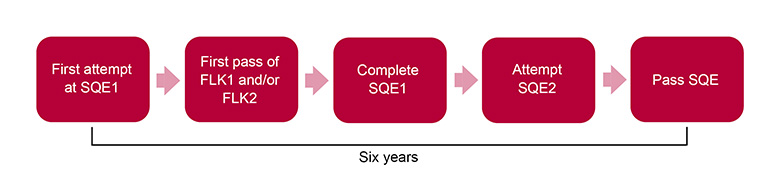
We propose that the validity period should be considered independently for each candidate's assessment from the date their assessment was passed. We are proposing changing the start date to the date an assessment was passed is appropriate for the following reasons.
First, the validity period should start when a candidate passes an assessment, rather than when they first attempt it. Put simply, a pass provides the evidence from which the validity period should run. This is because a candidate who fails has not yet demonstrated the required knowledge and skills and must pass the assessment before progressing through the SQE. The period intended to protect against knowledge and skills becoming outdated should therefore begin when that standard has been demonstrated.
Second, for resitting candidates it means they will have more time to complete all the SQE assessments as the time between their first attempt and first pass will not count as part of the validity period, giving them more time to complete the SQE.
We propose to retain the six years as we consider it to be proportionate – it will continue to ensure that candidates' legal knowledge and skills are sufficient and current at the point of qualification. Six years also aligns with the apprenticeship delivery model and allows sufficient time for part-time candidates to complete the SQE exams and required qualifying work experience (QWE).
'Rolling' validity period
Currently, candidates who do not pass all stages of the SQE within six years of the first attempt need to reapply and previous passes are not carried forward. This means if they wish to progress, they must start their SQE pathway again from the beginning.
In future, we propose that each FLK assessment's validity period is set independently. Candidates would still need to re-complete assessments that fall outside the rolling six-year period, but we expect this change will benefit candidates that might take longer to complete the SQE, or who have significant gaps between sitting FLK1 and FLK2 by increasing the duration that each assessment is valid. The benefits might be more pronounced for apprenticeship candidates, or candidates who are working, and/or with caring, or other responsibilities. Candidates will still need to complete SQE1 in its entirety before attempting SQE2.
Below is an illustrative example of how a rolling window could work in theory. Note this example is illustrative only. We do not expect there to be many, if any, candidates that would follow this path.
Figure 2: Proposed approach to the validity period; illustrative only
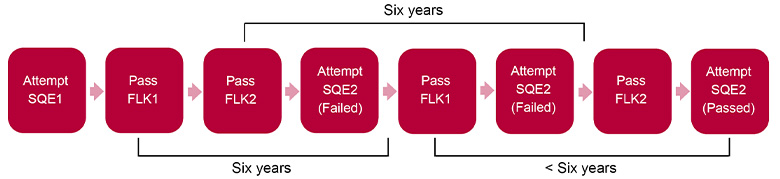
Further worked examples are available in Annex 5.
Question 6
To what extent do you agree or disagree with the proposal for FLK1 and FLK2 to remain valid for six years from the date the candidate passes the assessment?
Question 7
Are there any implications (positive or negative), for you or your organisation if FLK1 and FLK2 passes remained valid for six years from the date the candidate passes that assessment?
Should these changes be made to the Assessment Regulations, there will be important implications for current candidates as well as future candidates.
Our intention is for current candidates to be able to act under the new regulations from the date they come into force, rather than being bound by previous rules.
There are groups of candidates that might particularly benefit from this approach as set out below. If changes go ahead, we will issue detailed guidance to all affected candidates ahead of the new regulations coming into force as our proposals might change subject to consultation feedback.
Candidates who have failed an SQE assessment three times
There is a population of candidates who have failed an SQE assessment three times. Under the current regulations, candidates must wait for six years from the date of the first assessment attempted and restart the pathway from the beginning should they wish to continue to pursue the SQE.
From the date the new regulations are introduced, we intend that this cohort of candidates will be able to attempt the SQE again, and that their previous passes can be restored. They will still need to complete the SQE within the validity period, but each FLK pass will be valid independently for six years from the date it was passed.
Current candidates who have failed some SQE assessments.
For candidates that have failed an SQE assessment, the new regulations will allow them to carry over other passes for a rolling six-year period. We will apply the new start date of the validity period to previously passed assessments when the new regulations come into force.
We anticipate there will be few candidates who will immediately benefit given the small numbers of candidates who are close to the end of their six-year validity period, but as the SQE continues in operation there will be increasing numbers of candidates who will benefit from the assessments they passed being valid for longer.
Candidates whose validity period expires before, or close to, the date the new regulations come into force
The new regulations are unlikely to be introduced within six years of the first SQE sittings in November 2021 – that is to say by November 2027. This means that the current period of validity will end for candidates who sat one of the very early sittings of the SQE, are yet to complete the SQE assessment pathway (and have not failed an assessment three times). Under the current regulations, these candidates will need to start again entirely as previous passes will not be carried forward.
While we do not anticipate there to be many candidates in this group, this group will grow the longer it takes to implement our proposals. For candidates on the cusp of this group, we will issue guidance outlining in more detail how they will be affected by the proposed changes.
Therefore, this group of candidates will benefit from the change to the validity period start date as prior passes will become valid again so long as they were less than six years old when the new regulations come into force.
Over the past five years, we have learnt lessons from the current Assessment Regulations, which have been in place since the SQE's inception. We propose to amend some of these regulations to improve operational efficiency and reduce duplication of work – notably relating to the Assessment Board's oversight role.
The Assessment Board is the governing body responsible for overseeing the validity, reliability, and fairness of the SQE – it sits after each SQE delivery and approves the pass mark. The Assessment Board also considers and approves recommendations referred to them by the Mitigating Circumstances Panels, and makes decisions on allegations of malpractice, including the sanction – these two areas are the focus of the changes proposed. The Assessment Board's role and responsibilities are set out in the current SQE Assessment Regulations.
We have considered our proposals against other regulators of similar professional assessments. There is not a uniform approach, however of the bodies that we have looked at, the processes for considering mitigating circumstances claims are generally made by external panels, and not its assessment board. For malpractice claims, most other regulators operate a system with separate misconduct or disciplinary panels which consider and make decisions rather than an assessment board. Candidates are also permitted a route of appeal, which is generally before a panel which is separate from both the decision maker, and the assessment board.
SQE Mitigating Circumstances claims
Candidates who consider that their performance in an SQE assessment was affected by a mistake or irregularity in the administration of the assessment, bias in the conduct of the assessment, or personal circumstances, such as bereavement or illness, can submit a claim for mitigating circumstances.
These claims are considered by a Mitigating Circumstances Panel (MCP), composed of one SRA member and two Kaplan members, and involves considerable preparation including a full review of the evidence submitted for each of the claims. The MCP discusses each claim, agrees to a recommended course of action, and provides the board a report of recommendations with a short rationale for each decision. The Assessment Board then reviews and makes final decisions on the claims.
Under the current process, both the MCP and the Assessment Board review and consider the claims – our proposal is to streamline this process to permit the MCP to make final decisions instead of the Assessment Board. Making this change will increase efficiency and consistency, remove duplication and provide clarity for candidates about who is making the decision. It will also allow the Assessment Board to focus its attention on its core role of scrutinising data from the assessments to determine the pass marks. The Assessment Board will receive an overview of the MCP's decisions to provide assurance the process is running correctly.
Candidates will continue to have the right of appeal against the decision of the MCP via the appeals process outlined in the Assessment Regulations so the proposed change will not have a detrimental effect on SQE candidates.
SQE malpractice and improper conduct allegations
Candidates who are disruptive or carry out any activity which could result in either the candidate or another candidate obtaining an unfair advantage in connection with the SQE, such as copying another candidate's answer, taking notes into the assessment or communicating with other candidates, are subject to the malpractice and improper conduct regulations and procedures.
Malpractice cases are considered by a special panel (the panel) made up of three solicitors who may be Kaplan staff or independent members. The panel is chaired by an independent member. The candidate is given the opportunity of making oral and/or written representations to the panel. Where the panel makes a finding of malpractice or improper conduct, it is referred to the Assessment Board to confirm the finding and decide on the sanction that should be imposed.
Again, both the special panel and the Assessment Board review the evidence to make determinations in respect of malpractice cases. The Assessment Board, rather than the panel, decides on the candidate's sanction.
We propose to streamline the malpractice process by changing the Assessment Regulations to allow the panel to make the decisions on both the finding of malpractice and the sanction, without referral to the Assessment Board. We propose to change the composition of the panel to include a representative from the SRA as well as a representative from Kaplan. These representatives might be practising or non-practising solicitors. SRA membership will serve to promote the public interest, and the Kaplan representative will bring SQE/assessment specific knowledge to the panel. The panel would continue to be chaired by an independent member who is also a qualified solicitor of England and Wales to ensure the profession is represented in the deliberations.
Making these changes will increase efficiency and consistency, remove duplication and provide clarity for candidates about who is making the decisions. It will allow the decision about the sanction to be made by the panel that makes the finding of malpractice, which has sight of all the evidence and oral representations made by the candidate during the panel. It will also allow the Assessment Board to focus its attention on its core role of scrutinising data from the assessments to determine the pass marks. The SRA will continue to retain oversight and assurance of the malpractice process through our representation on the panel, regular reporting and meetings with Kaplan, and a report to the Assessment Board on volumes of cases and outcomes.
Candidates will continue to have the right of appeal against the decisions of the panel via the appeals process.
Other minor wording changes
We are making a change to the definition of Mitigating Circumstances. We intend to remove reference to 'marks and performance' and refer only to 'performance'. We expect this change will be advantageous for candidates as it can be difficult to determine whether their mark was materially and adversely affected. If we limit circumstances considered to instances where a candidate would have passed but for the mitigating circumstance, this will exclude situations where through no fault of their own a candidate has had a poor testing experience, which may have affected their performance.
In Annex 1 there is a summary of the minor wording changes we are proposing alongside a rationale for these changes.
Implementation
There are no costs or significant process changes required to implement these amendments and minor changes. We are therefore proposing to implement them separately to proposals 1 to 3 to ensure the benefits of this change are in place quickly.
Thus, we are consulting on two sets of Regulations, Annex 3 which sets out the initial regulatory changes for proposal 4, and Annex 4 which sets out the regulatory changes required to implement proposals 1 to 3 once the necessary preparatory work has been completed.
Question 8
To what extent do you agree or disagree with the proposal for the Mitigating Circumstances Panel, rather than the Assessment Board, to make final decisions on SQE mitigating circumstances claims?
Question 9
To what extent do you agree or disagree with the proposal for the special panel to decide whether malpractice has occurred and what sanction to impose, without referring the case to the Assessment Board?
Question 10
To what extent do you agree or disagree with the proposed minor wording amendments to the Assessment Regulations set out in Annex 1?
Question 11
Are there any implications (positive or negative), for you or your organisation if these changes to SQE mitigating circumstances and malpractice processes, and other minor amendments, are implemented?
We have produced an initial Equality Impact Assessment on our proposed changes at Annex 2.
Question 12
Do you have any comments on the regulatory impact of our proposed changes to the Assessment Regulations? In particular, are there any impacts or unintended consequences that you think we have not identified? Please include supporting evidence where possible.
Question 13
Do you have any comments on our draft equality impact assessment? In particular, are there any impacts on particular groups that you think we have not considered? Please include supporting evidence where possible.
Question 14
Do you have any further comments on our proposed changes to the Assessment Regulations that you would like to share with us?
Question 1
To what extent do you agree or disagree with the proposal to remove the requirement for candidates to take FLK1 and FLK2 in the same assessment window?
Question 2
If candidates could take FLK1 and FLK2 in separate assessment windows, which of the following scheduling options would be important to you or your organisation?
- the ability to progress quickly from an FLK to the next FLK sitting
- the ability to take either FLK at any SQE1 sitting
- the ability to have a large period of time between FLK sittings (eg more than two or three months)
- the ability to attempt SQE1 (ie both FLK1 and FLK2) in January and SQE2 in April (in time for results to be issued before September)
- the ability to progress quickly from SQE1 to SQE2
- other.
Question 3
Are there any implications (positive or negative), for you or your organisation if the requirement to take FLK1 and FLK2 in the same assessment window was removed?
Question 4
To what extent do you agree or disagree with the proposal to remove the limit on the number of attempts candidates can make at each SQE assessment: FLK1, FLK2 and SQE2? Please explain your answer.
Question 5
Are there any implications (positive or negative), for you or your organisation if the limit on the number of attempts candidates can make at each SQE assessment were removed?
Question 6
To what extent do you agree or disagree with the proposal for FLK1 and FLK2 to remain valid for six years from the date the candidate passes the assessment?
Question 7
Are there any implications (positive or negative), for you or your organisation if FLK1 and FLK2 passes remained valid for six years from the date the candidate passes that assessment?
Question 8
To what extent do you agree or disagree with the proposal for the Mitigating Circumstances Panel, rather than the Assessment Board, to make final decisions on SQE mitigating circumstances claims?
Question 9
To what extent do you agree or disagree with the proposal for the special panel to decide whether malpractice has occurred and what sanction to impose, without referring the case to the Assessment Board?
Question 10
To what extent do you agree or disagree with the proposed minor wording amendments to the Assessment Regulations set out in Annex 1?
Question 11
Are there any implications (positive or negative), for you or your organisation if these changes to SQE mitigating circumstances and malpractice processes, and other minor amendments, are implemented?
Question 12
Do you have any comments on the regulatory impact of our proposed changes to the Assessment Regulations? In particular, are there any impacts or unintended consequences that you think we have not identified? Please include supporting evidence where possible.
Question 13
Do you have any comments on our draft equality impact assessment? In particular, are there any impacts on particular groups that you think we have not considered? Please include supporting evidence where possible.
Question 14
Do you have any further comments on our proposed changes to the Assessment Regulations that you would like to share with us?
How to respond
Online questionnaire
The consultation period will end on Thursday 11 February 2027 at 23.59.
Our online consultation questionnaire is a convenient, flexible way to respond. You can save a partial response online and complete it later. You can download a copy of your response before you submit it.
Reasonable adjustment requests and questions
We offer reasonable adjustments. Read our policy to find out more.
If you need to respond to this consultation using a different format or if you have any questions about the consultation, please contact us.
Publishing responses
We will publish and attribute your response unless you request otherwise.
Downloads
- Consultation: SQE assessment regulations consultation (PDF 19 pages, 402KB)
- Annex 1 - Table of proposed changes and rationale of the SQE Assessment Regulations (PDF 7 pages, 162KB)
- Annex 2 - SQE Initial Equality Impact Assessment (PDF 9 pages, 302KB)
- Annex 3 - SRA SQE Assessment Regulations - First set (PDF 7 pages, 199KB)
- Annex 4 - SRA SQE Assessment Regulations - Second Set (PDF 7 pages, 198KB)
- Annex 5 - Worked Examples of Rolling Validity Period (PDF 7 pages, 196KB)
- SQE consultation - improving flexibility while maintaining standards (PDF 1 page, 78KB)